
Advocacy in KOTA

The Kentucky State Capitol in Frankfort, KY.
(Image credit: Mobilus In Mobili, CC BY-SA 2.0, via Wikimedia Commons)
The Kentucky Occupational Therapy Association is committed to advancing the profession of occupational therapy through active engagement in professional and legislative advocacy efforts that support practitioners, students, and the clients they serve. KOTA promotes awareness of policy issues impacting reimbursement, scope of practice, healthcare access, and occupational performance while encouraging members to move beyond talking about advocacy and actively participate in shaping the future of the profession. Through educational resources, legislative updates, and collaboration with initiatives such as the Occupational Therapy Compact Commission, KOTA works to strengthen professional mobility, support practitioner voices, and ensure occupational therapy remains valued and accessible across Kentucky.

The full presentation on can be viewed here:
Link to the Jeopardy activity from the presentation. Test your knowledge!
Legislative Efforts and Resources
Recent Success: OT Interstate Licensure Compact
Originally presented in 2022, the KOTA wrote and presented legislation to begin the process of joining the Occupational Therapy Compact; allowing eligible occupational therapy practitioners to obtain compact privileges to practice in participating states without completing separate state licensure applications. Following the passage of the initial legislation, the Kentucky Board of Licensure for Occupational Therapy (KBLOT) began working alongside the Occupational Therapy Compact Commission to develop and coordinate the implementation process with participating states. During this process, challenges arose relating to how practitioners would obtain the federal level background check needed to obtain practice privileges in participating states. In resolving this issue, occupational therapists collaborated with speech-language pathologists, social workers, and physical therapists to present additional legislation defining the background check process. The OT Compact was reintroduced in 2026 with the addendum of HB 657 (2026), clarifying the federal background check process with clear definitions and direct access pathways for practitioners to complete federal level background checks. With the development of this process and continued collaboration with the Compact Commission, it is anticipated that Kentucky will begin issuing compact privileges within 2026.
Legislative Advocacy
National Level:
Medicaid is a joint federal and state program, where occupational therapy services vary state by state. Contacting your state association can provide greater insight into our states individual policies and reimbursement issues. In addition, membership with the American Occupational Therapy Association provides access to national- comprehensive resources, advocacy, and reimbursement support. AOTA advocates at both the national level on Medicare and federal policy relating to Medicaid. Supporting both organizations helps strengthen reimbursement advocacy while sustaining the advancement of occupational therapy services nationwide.
Resources to stay engaged and up to date with Kentucky’s legislative processes:
KY LRC Committee Meetings: Official YouTube channel for live streamed and archived recordings of Kentucky committee meetings.
AOTA Everyday Advocacy: Informative information, examples, and resources for incorporating advocacy into your daily routine.
AOTA Legislative Action Center: Access to federal initiatives and templates to be used for contacting policy makers.
Bill Watch: website dedicated to keeping users up to date and allowing tracking of legislation during the Kentucky Legislative Session.
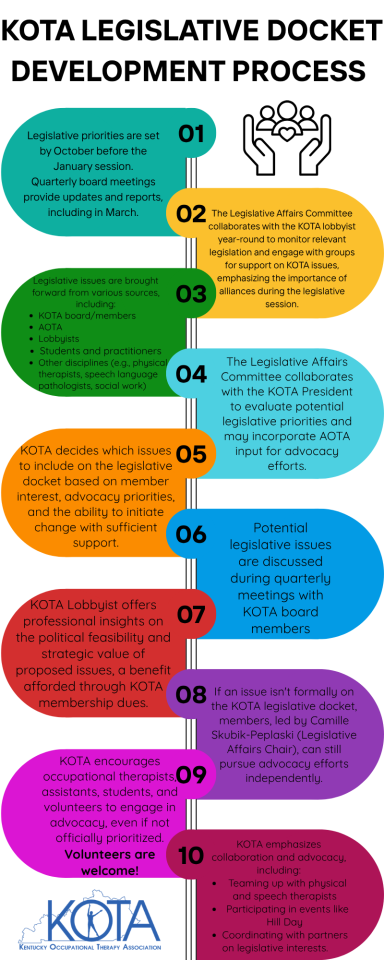
KOTA Legislative Docket Development Process
On an annual basis,
-
Legislative priorities for the upcoming session are typically identified and finalized by October, prior to the legislative session beginning in January.
-
Updates and reports are shared during quarterly board meetings, including meetings held in March and throughout the year.
-
Legislative Affairs Committee communicates throughout the year with the KOTA lobbyist to follow any appropriate legislation or issue that could affect our practice. We make contact with any group that we have issue with or to ask for a group support for KOTA legislation. Alliance is critical throughout the year to ensure support during the legislative session.
How Issues Are Identified
Legislative issues may be brought forward from a variety of sources, including:
-
KOTA members
-
The KOTA Board
-
The KOTA President
-
The Legislative Affairs Committee
-
American Occupational Therapy Association (AOTA)
-
Lobbyists
-
Emerging issues identified during the year by students, practitioners, etc.
-
Other disciplines or groups (physical therapists, speech language pathologist, athletic trainers)
The Legislative Affairs Committee works closely with the KOTA President to review and discuss potential legislative priorities. Input from AOTA may also be incorporated when relevant to national or state advocacy efforts.
Decision-Making Process
-
Potential legislative issues are discussed during quarterly meetings with KOTA board members.
-
The Lobbyist provides professional insight regarding the political feasibility and strategic value of proposed issues (this position is solely afforded through KOTA membership dues).
-
Following discussion, member interest, advocacy priorities, and practicality regarding ability to initiate change with adequate support, KOTA determines which issues will officially be included on the legislative docket for the upcoming session.
Advocacy Beyond the Official Docket
If an issue is not formally adopted onto the KOTA legislative docket:
-
Individual members, typically led by Camille Skubik-Peplaski (Legislative Affairs Chair), may still independently pursue related advocacy efforts (KOTA is an organization that runs on volunteer efforts from the OT community! Additional volunteers are ALWAYS welcome! Be a part of the change you wish to see!
-
KOTA encourages occupational therapists, occupational therapy assistants, occupational therapy students, occupational therapist assistant students and volunteers to become involved in advocacy initiatives they are passionate about, even if those initiatives are not officially endorsed as legislative priorities.
Collaboration and Coalition Building
KOTA values interprofessional collaboration and coalition advocacy efforts. Examples include:
-
Occupational therapists working alongside physical therapists and speech-language pathologists
-
Participation in collaborative advocacy events such as Hill Day
-
Coordinated efforts with partner organizations when legislative interests overlap
Advocacy information and FAQ researched and written by Jaden Johnson.


_(cropped).jpg)